
What our 211 data tells us about working families in Greater Cleveland
Employment remains one of the strongest pathways to financial stability, but our data shows that many working families struggle to afford essential expenses. Understanding these patterns helps identify where community resources are working, where gaps remain, and where investment can have the greatest impact.
The 2026 United For ALICE Report highlights a growing reality across Greater Cleveland. While employment has increased and poverty has declined over the past decade, many households continue to struggle to afford the necessities of everyday life.
United Way 211 provides a real-time view of what that looks like in our community.
Every day, our navigators connect residents with resources for housing, food, utilities, transportation, employment, and other essential needs. Together, those conversations provide insight into the challenges working families are facing and how those challenges are changing.
Working families are increasingly seeking assistance
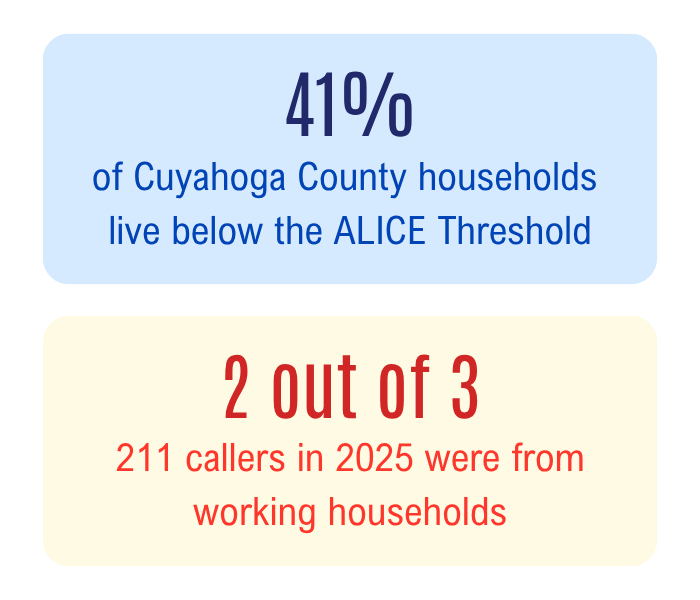
According to the 2026 United For ALICE Report, 41% of Cuyahoga County households live below the ALICE Threshold, the minimum income needed to afford basic household expenses.
Our 211 data provides additional context to that finding. In 2025, two out of three callers were estimated to be from working households, indicating that many people seeking assistance are already employed.
Together, these findings suggest that financial hardship is increasingly affecting working households.
Employment remains one of the strongest pathways to economic mobility, but for many families it no longer provides enough stability to keep pace with rising housing costs and other essential expenses.
Financial challenges are interconnected
The data also shows that the challenges working families face rarely occur in isolation. Many people calling for help with employment also needed help with food, shelter, and/or utilities.
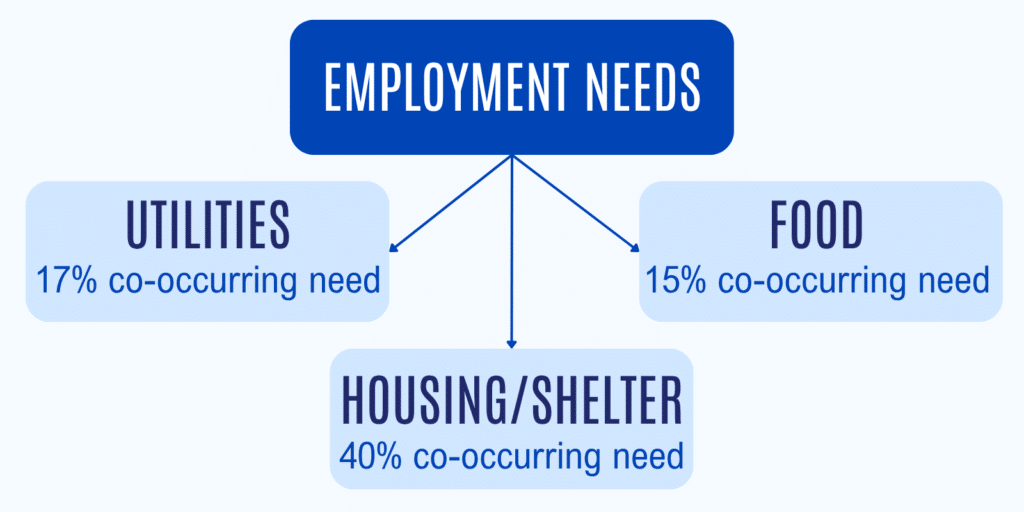
This illustrates how barriers to employment and financial stability often overlap.
A rent increase, utility bill, unexpected medical expense, or loss of reliable transportation can place additional pressure on a household budget and make it more difficult to remain employed. In other cases, a disruption in employment can quickly affect a family’s ability to afford housing, food, and other essentials.
Understanding these connections is essential to strengthening economic mobility. Working families often need coordinated support across several areas rather than assistance with a single, isolated challenge.
Understanding the experiences behind the data
The numbers show an important trend, but behind every data point is someone working to hold their family’s stability together.
Maria’s experience is one our 211 navigators encounter often. She works full time while supporting her teenage son. After her rent increased, school expenses accumulated, and her car needed an unexpected repair, she struggled to keep up with monthly expenses. Without reliable transportation, getting to work became increasingly difficult.
When Maria contacted United Way 211, a navigator connected her with food assistance, utility assistance, and temporary transportation support that allowed her to remain employed while addressing her immediate needs.
Her greatest challenge, however, remained rent. Like many working families, she earned too much to qualify for many assistance programs, but not enough to comfortably absorb rising housing costs. Her experience reflects patterns our navigators see across thousands of conversations each year.
From insight to action
The insights generated through United Way 211 help inform how we invest in programs, strengthen partnerships, and advocate for policies that support working families. That work takes several forms.
- United Way 211 remains the front door to this effort, connecting residents with community resources while identifying emerging trends that guide where investment is needed most.
- Bridges@Work extends that reach into the workplace, partnering with employers to provide resource navigation, financial coaching, and benefits support that help employees remain stable before financial challenges become workplace crises.
- Our Economic Mobility grants support organizations helping families strengthen financial stability, while our Benefits Cliff advocacy focuses further upstream, working to reduce systemic barriers that make it difficult for working households to move forward as their earnings increase.
This article is the first in our Community Insights series. In the coming months, we’ll explore what our 211 data tells us about housing affordability, transportation, food security, and other issues affecting economic mobility.
By sharing these insights, we hope to strengthen understanding of the challenges facing Greater Cleveland and encourage collaboration around solutions that help more families move from crisis to stability and toward possibility.
This article was drafted with the assistance of generative AI and edited and fact-checked by the author.