
What the 2025 government shutdown revealed about food insecurity in Greater Cleveland
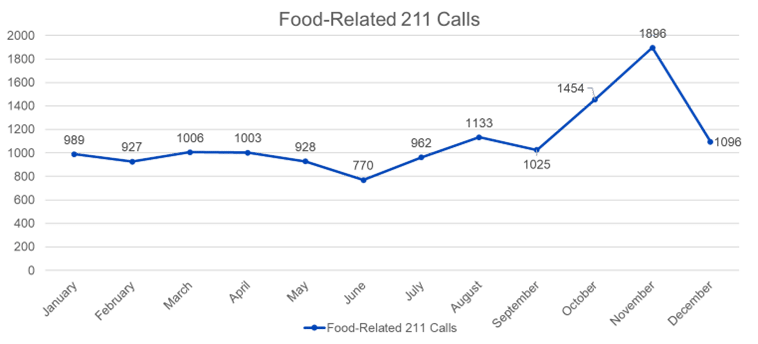
- Calls for food help rose sharply during the 2025 disruption in SNAP assistance, even before benefits were paused
- This increase shows how many Greater Cleveland families rely on consistent food support
- Requests for eviction help also spiked, showing how quickly housing stability is affected when food budgets tighten
For many households in Greater Cleveland, food insecurity is not a distant crisis. It is something families manage day to day through careful budgeting and help from the Supplemental Nutrition Assistance Program (SNAP). When that support is disrupted, even briefly, the effects surface quickly. Our 211 call data from the 2025 federal government shutdown shows just how close many families are to the edge. For many families, SNAP is what makes the grocery budget work each month.
How the disruption unfolded
In October 2025, people began hearing that November SNAP benefits may not be funded. As news spread, calls to our 211 helpline for food assistance began to rise. The possibility of losing benefits was enough to make people look for help.
In November, SNAP benefits were paused for a few weeks. Calls for food help increased even more, and over the course of October and November, nearly 3,700 residents contacted 211 seeking help with food. Food became the top need, overtaking housing and utilities.
What the data shows about food insecurity
In Cuyahoga County, an estimated 15 percent of residents are food insecure, including more than one in four children. SNAP is the largest source of food assistance for these households, providing far more support than food banks. When benefits are delayed or paused, even temporarily, families feel the strain immediately.
The fact that uncertainty itself prompted an increase in calls for help also shows how little flexibility there is in household budgets. Many 211 callers are part of the ALICE population (Asset Limited, Income Constrained, Employed), those earning above the federal poverty level but still struggling to afford basic necessities such as housing, childcare, transportation and food. Two out of three callers to 211 are employed, and rely on stable benefits to support their families.
The connection between food and housing
Our data also shows that concerns about SNAP benefits had broader effects than increased need for food assistance. Visits to the website supporting Cleveland’s Right to Counsel program, FreeEvictionHelp.org, rose suddenly in late October 2025 and remained unusually high through mid-November. More residents filled out the eviction help eligibility survey during this time than any other period in the last year. Housing calls to 211 rose in December, likely as families adjusted their budgets after the SNAP disruption.
This increase in eviction help requests shows how closely food and housing are connected. When grocery budgets tighten, rent becomes harder to manage. A disruption in one stabilizing support can quickly strain others.
How we responded to the SNAP benefits disruption
During the benefits pause, many private, public, and nonprofit organizations stepped up to provide more food support. Many food pantries expanded hours or added distributions to meet higher demand, resulting in rapid changes in food availability at different locations.
To help residents find food during these changes, we launched an AI-enabled Food Resource Finder that helps people locate nearby options online. Behind the scenes, our 211 team made nearly 8,000 updates to the resource database to keep pantry schedules and emergency food information accurate. We also added staff and used call-back features to reduce wait times.
These efforts helped ensure that when residents reached out during a period of uncertainty, they could quickly access accurate, up-to-date information.
What the SNAP disruption revealed
The pause in SNAP benefits during fall 2025 was temporary, but it shows how much financial stress many households in Greater Cleveland are already under. For many working families, reliable benefits are what help keep food on the table. When those benefits are uncertain, families face difficult choices about what bills to pay and where to cut back. The increase in calls about food and eviction during and after the shutdown shows how little room many households have in their budgets.
At the same time, those calls help us see what challenges families are starting to face. SNAP provides the foundation for food access, while emergency food providers and local infrastructure respond when gaps appear. When funding is reduced or benefits are uncertain, pressure shifts quickly to families and to the organizations working to support them.
The role of 211
United Way 211 provides both a direct line to help and a window into how our community is experiencing change. When residents call 211, they are connected to resources that can meet their needs in real time, even when availability of support is rapidly changing.
At the same time, the patterns in those calls help us understand emerging pressures across the region. During the SNAP disruption, 211 connected thousands of residents to food resources while also revealing how quickly uncertainty can ripple through household budgets.
Together, those roles ensure that when need surfaces, our community can respond quickly and with a clearer understanding of what families are facing.
This article was drafted with the assistance of generative AI and edited and fact-checked by the author.