
What our 211 data tells us about HOUSING in Greater Cleveland
For a growing number of working households in Greater Cleveland, keeping up with rent in the face of rising costs of living is a struggle. And when people fall behind on rent, many find they are not eligible for rental assistance.
We see this repeatedly in calls to our 211 helpline. Each year, thousands of Cuyahoga County residents call for help with rent or a security deposit, and the local programs that exist are narrowly restricted or too small to meet the need. Rent payment assistance calls generate more unmet requests than any other single service we track.
In our first Community Insights article, we shared what our 211 data reveals about working families: a job no longer guarantees financial stability. For a growing share of callers, that instability shows up first as a housing crisis.
WHEN HELP EXISTS, BUT NOT FOR YOU
Housing and shelter needs have grown faster than any other category of 211 request, concentrated in one place: rent. Most households fall behind because the cost of living is rising faster than paychecks. A rent increase, a change in take-home pay, the rising cost of household goods, or an unexpected bill causes a shortage in cash for rent.
When someone calls 211 for help with rent, our navigators often have limited resources to offer. Very few rent assistance programs serve general working households; most rent resources are restricted to individuals within a specific group, such as veterans, people with documented disabilities, or those experiencing chronic homelessness.
A working household facing a rent hike often finds no program built for them.
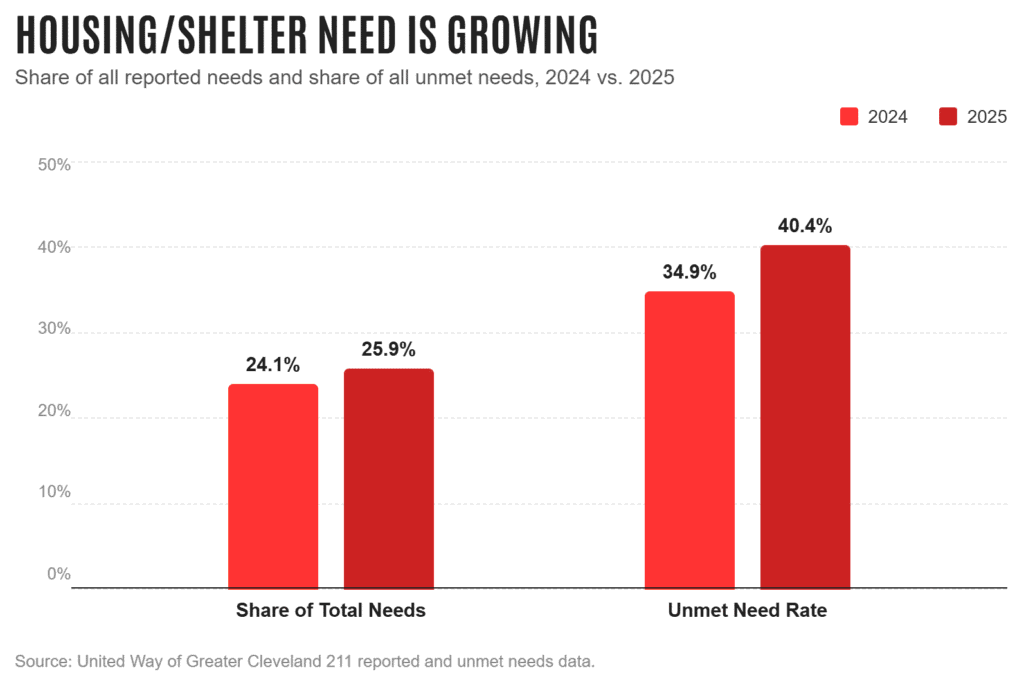
Nearly one in four requests for rent payment assistance went unmet in 2025, meaning that the 211 Navigator could not identify an appropriate resource for the 211 caller. Requests for a rental deposit, often the barrier to a more affordable unit, were unmet even more often. These unmet requests can mean eviction, a move into housing that is unsafe or overcrowded, or a disruption to a child’s school routine.
THE SAME PATTERN, SEEN FROM A DIFFERENT ANGLE
This isn’t a story only our data tells. United For ALICE is a research initiative whose name stands for Asset Limited, Income Constrained, Employed and describes the realities of working households that earn more than the poverty level but less than the cost of essentials. People below the ALICE threshold do not make enough to afford basic needs in their region.
The ALICE Economic Viability Dashboard shows that among Cuyahoga County renters below the ALICE threshold, over two-thirds carry a high rent burden. In Geauga County, a little over half of renters below the ALICE threshold are rent-burdened.
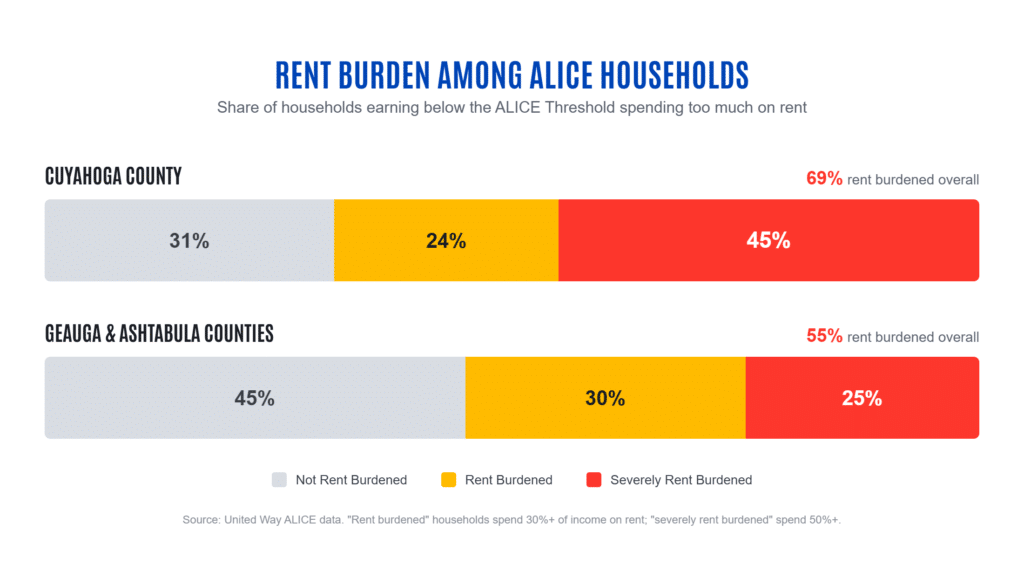
Carrying that kind of rent burden leaves less room in a monthly budget for food, utilities, transportation, and health care, and no room to absorb a reduced work schedule or unexpected expense. For many households, the reality is that rent is already difficult to pay in full every month, and any extra one-time expense can result in falling behind.
Cuyahoga County’s 2025 Countywide Housing Study points to a related gap: the county’s homeownership rate, 58.4 percent, also trails Ohio’s 66.8 percent. This means more Greater Clevelanders are exposed to a rental market that can raise their housing cost each year, while homeowners with a fixed-rate mortgage have steady payment costs and can build a financial cushion through home equity.
Taken together, the data on rent-burdened renters and the data on the high need for rental assistance paint a picture of a complex housing affordability crisis in Greater Cleveland.
WHAT IT ACTUALLY COSTS TO GET BY
The ALICE Household Survival Budget illuminates another aspect of the affordability crisis: inadequate wages.
In Cuyahoga County in 2024, a family of two adults and two children needed a monthly income of $75,000 to $95,000 for basic living expenses (depending on whether their children were in care), well above the county’s median household income of $65,974 and the federal poverty level of $31,200 for a family of four.
Many working individuals and families simply do not earn enough to consistently afford rent, food, utilities, transportation, health care, and other essential needs. Without adequate assistance programs to help people weather rent shortfalls, housing stability is out of reach for those earning wages below the ALICE threshold.
WHAT THIS MEANS FOR GREATER CLEVELAND
Our 211 data, the county’s housing study, and the ALICE survival budget describe the same two-part problem.
First, affordability: rent and other expenses are rising faster than wages for a growing share of working households. The region has an inadequate supply of affordable, quality rental housing.
Second, access to support: when many households look for help, they find that assistance programs weren’t designed for them, and what exists doesn’t operate at a scale matching the need. Closing the gap would require expanding rent and deposit assistance for working households who currently fall outside eligibility.
Research on housing instability reinforces why this matters beyond housing alone. A 2016 Stanford study of low-income renters found that workers who experienced a forced move, such as an eviction, were 11 to 22 percentage points more likely to subsequently lose their job. Housing stability is closely linked to stable employment, school attendance, and other individual and community-level outcomes.
how united way and partners are responding
United Way of Greater Cleveland makes strategic investments in housing stability through multiple programs and partnerships.
The Siemer Family Stability Initiative offers short-term, flexible assistance for households facing housing instability, including rent and utility support.
Our Tenants’ Resources program, supported by the City of Cleveland, funds multiple partners who work with tenant organizing, education, and landlord-tenant mediation, helping renters understand their rights and advocate for better housing conditions.
Our Economic Mobility grants target housing stability as one of three key investment areas.
United Way 211 keeps connecting residents to available resources while documenting where gaps persist, and our Benefits Cliff advocacy addresses one of the structural forces that keeps working households from building enough of a cushion to absorb a rent increase.
No single initiative can solve a complex problem like this alone, but together they form a coordinated response shaped directly by the data.
Housing stability underlies nearly every other measure of a family’s wellbeing. Closing the rent affordability gap is one of the clearest opportunities Greater Cleveland has to help more working families move from crisis to stability, and toward possibility.
This is the second article in our Community Insights series. Next month, we examine what our 211 data reveals about transportation as a barrier to workforce stability.
This article was drafted with the assistance of generative AI and edited and fact-checked by the author.